
Cedar vs spruceWhat actually changes?
Cedar and spruce have recognisable tendencies, but the better choice comes from the complete guitar: its response, character and what its maker has done with the wood.
 Cedar
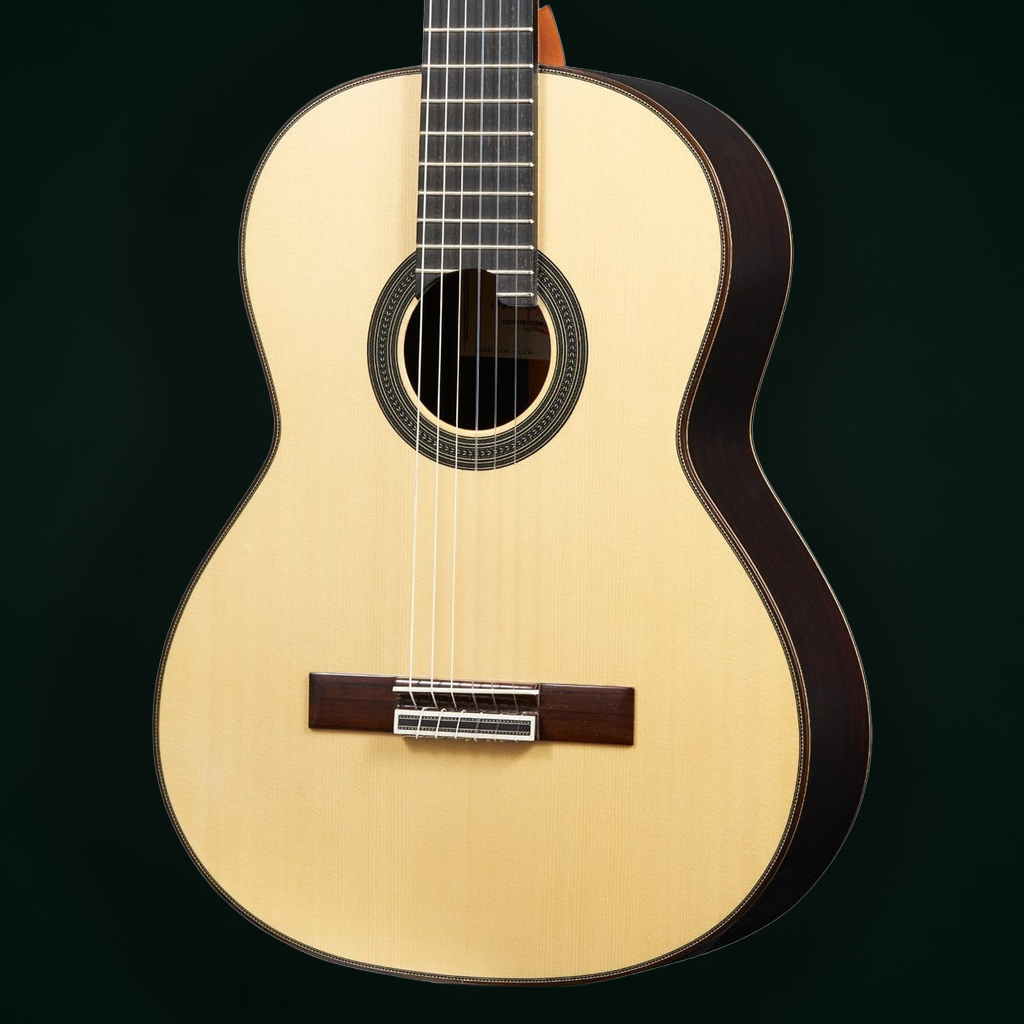 Spruce
Cedar or spruce? It is one of the first choices you are likely to encounter when looking for a classical guitar, and one of the easiest to oversimplify.
The usual explanation is that cedar sounds warm and dark while spruce sounds bright and clear. There is some truth in this, but it can also create a misleading picture of what two guitars will actually sound — and feel — like.
A good cedar guitar can be clear, colourful and powerful. A good spruce guitar can be warm, responsive and remarkably rich. Once you start comparing instruments from different makers, with different bracing systems and different approaches to construction, the neat distinction between the two woods begins to break down.
The soundboard still matters enormously. But it is better thought of as one important part of a complete instrument, rather than a specification that determines its character on its own.
Understanding the tendencies of cedar and spruce is useful. Knowing when to ignore them is even more useful.
The short answer
If you are comparing otherwise similar classical guitars:
- Cedar often feels immediately responsive, producing a full sound without requiring much effort from the player.
- Spruce often gives greater clarity and separation, with plenty of room to alter the sound through changes in touch.
- Cedar is commonly associated with a darker, rounder character; spruce with a clearer, more open one.1
- These are tendencies, not rules. The maker, construction, bracing, thickness and mechanical properties of the individual soundboard can substantially alter the result.2
- Neither wood is inherently better, nor is one reserved for beginners and the other for advanced players.
The most useful question is therefore not simply “Do I want cedar or spruce?” but “What kind of response and character am I looking for from the guitar?”
Why does the soundboard matter so much?

The soundboard — the front of the guitar — is the principal radiating surface of the instrument. Energy from the vibrating strings passes through the bridge into the guitar body, with the soundboard playing a particularly important role in transmitting and radiating that vibration.2
That creates a difficult job for the maker. The top needs to be light enough to respond freely while remaining sufficiently stiff and stable to withstand string tension and behave in a controlled way.
Spruce and Western red cedar have both proved particularly suitable for this purpose, but they do not have identical physical properties. Research into musical-instrument woods shows meaningful differences in density, stiffness and internal damping between Western red cedar and the spruces traditionally used for soundboards.2
Those differences matter, but they do not dictate a finished guitar's sound.
A maker can alter the thickness of the soundboard, its bracing and numerous other aspects of the construction according to the particular piece of wood being used. Research into tonewoods specifically notes that differences between cedar and spruce can be accommodated through construction choices such as soundboard thickness.2
This is the crucial point:
You do not hear a piece of cedar or spruce in isolation. You hear what a particular maker has done with it.
Cedar is actually a relatively recent classical-guitar tradition
Spruce has a much longer history as the established soundboard material for the Spanish guitar. The widespread adoption of Western red cedar came much later.
The Ramírez workshop credits José Ramírez III with introducing red cedar to its concert guitars during his experiments in the early 1960s. The material was unconventional at the time, but its subsequent use spread widely throughout classical-guitar making.3
Today, cedar and spruce are both thoroughly established soundboard choices. Their coexistence also tells us something important: neither has rendered the other obsolete.
They simply offer makers different materials with which to work.
What does a cedar classical guitar usually sound like?
Cedar has a reputation for warmth, and there is good reason for it. Yamaha, for example, characterises Western red cedar as producing a softer, mellower sound in contrast with the clearer, tighter character it associates with spruce.1
Those descriptions are useful as a starting point, but in practice we find response at least as significant as tonal warmth.
A typical cedar guitar often gives notes a relatively rounded attack, with strong fundamentals and a full-bodied character. There can be an attractive density to the sound: notes appear quickly and the guitar may feel as though it is giving you a great deal in return for relatively little physical effort.
That immediacy is perhaps more useful to think about than simply describing cedar as “warm”.
Play quietly on a good cedar guitar and it will often still speak with conviction. For a player with a lighter right hand — including some players who use little nail or no nail at all — that responsiveness can be particularly attractive.
There is also something satisfying about the way many cedar guitars handle lyrical playing. A single melodic line can feel substantial without constantly having to work to produce body in the note.
But this should not be mistaken for a lack of clarity.
Some cedar guitars are exceptionally clean and articulate. Others can have bright, glossy trebles and considerable power. Construction changes the picture enormously.
The useful generalisation is therefore:
Cedar often gives the player an immediate, full response, particularly at lighter and moderate dynamics.
It is a tendency, not a specification.
What does a spruce classical guitar usually sound like?
Spruce often presents itself differently.
There can be greater space around individual notes, with a particularly attractive separation in polyphonic music. Contrapuntal lines can remain distinct rather than merging into a single body of sound.
It is also common to find considerable variation available through the right hand. Move the contact point, alter the angle of attack or change the weight of the stroke and a good spruce guitar may reward those changes with noticeably different colours.
This is where descriptions such as clear, open and transparent become useful.
Yet “bright” is often too crude.
Some spruce guitars are undoubtedly brilliant and incisive. Others can have deep basses, rounded trebles and considerable warmth. At concert level especially, we regularly encounter spruce guitars that bear very little resemblance to the simplistic idea of a thin or bright-sounding instrument.
Spruce can also give the player more sensation of space before the sound reaches its limit. A guitar that initially feels a little less immediate may continue changing as it is pushed harder, allowing a player to explore a particularly wide dynamic and tonal range.
Again, this is not universal.
A lightly constructed spruce guitar can be extraordinarily responsive, while a more heavily built one may feel considerably more resistant.
The more useful generalisation is:
Spruce often favours clarity, separation and the ability to shape the sound across a broad range of right-hand inputs.
Where the cedar-versus-spruce rule starts to fall apart

The difficulty comes when these generalisations are treated as specifications.
Imagine two guitars:
- a lightly built spruce guitar with a very flexible soundboard;
- a more heavily constructed cedar guitar with a substantially stiffer overall top.
It would be unwise to assume the cedar instrument must be the more responsive of the two simply because the word cedar appears on its specification sheet.
The same problem appears when comparing different construction systems.
A traditional fan-braced spruce guitar, a lattice-braced cedar guitar and a modern double-top instrument do not differ only in their choice of wood. Their makers are asking the soundboards to behave in fundamentally different ways.
Bracing provides structural support to the soundboard but also alters its vibrational behaviour and response. Changes to the body, scale length and other elements of the instrument add further variables.4
Even within the same broad construction method, individual pieces of wood differ. Luthier Douglass Scott describes working towards targets involving the soundboard's overall stiffness, mass and frequency response, rather than expecting the species of wood or a particular bracing pattern to determine the result by itself.5
That is a much better way of understanding the instrument.
Two pieces of spruce are not mechanically identical simply because they came from the same species of tree. Neither are two pieces of cedar.
And two makers can take similar materials and produce very different guitars.
What we notice when comparing real guitars
This is where handling guitars rather than specifications becomes important.
At Classical Guitar Academy, we see cedar and spruce instruments across a wide range of makers, construction styles and price points. One recurring lesson is that the differences between individual guitars are ultimately more important than the stereotypes attached to their soundboard woods.
Cedar can make an immediate impression. That first chord may arrive with weight, warmth and an effortless feeling under the fingers. This can be extremely appealing, particularly to a player moving from a relatively unresponsive student instrument.
Spruce sometimes asks for a little more exploration.
The first impression may be one of clarity rather than sheer fullness. Spend longer with the guitar, however, and its attraction may lie in how much the sound changes as you vary your right hand. Different colours become available; inner lines separate; playing nearer the bridge or fingerboard can alter the character considerably.
But we also encounter guitars that reverse those expectations.
Some spruce instruments are exceptionally immediate. Some cedar guitars have remarkable definition. A particularly fine guitar can possess qualities we would conventionally associate with both.
This becomes increasingly important as the quality of the instrument rises.
At concert level, choosing purely from a list of materials makes very little sense. The individual maker's approach becomes far more significant.
Response matters as much as sound
There is another part of this comparison that is difficult to appreciate from recordings: how the guitar behaves under the fingers.
Two guitars can sound equally impressive to a listener while feeling completely different to the player.
A responsive guitar makes it easy to initiate a note cleanly. You feel that small changes in the right hand are recognised rather than swallowed by the instrument.
For some players, the immediacy commonly associated with cedar feels liberating. They do not need to drive the instrument hard to produce a substantial sound.
Other players actively enjoy having more resistance available. They want to be able to lean into a note, develop it and explore the additional tonal possibilities that can sometimes accompany that feeling.
Neither preference represents a higher level of playing.
They are simply different relationships between player and instrument.
This is also one reason that recordings alone are an imperfect way to choose a guitar. A microphone can tell you a great deal about character, balance and colour. It cannot fully tell you what happened underneath the player's fingers to produce them.
Is cedar better for beginners?
Not necessarily.
There is a sensible argument behind the idea. A responsive cedar guitar can produce a satisfying sound with a relatively light touch, and that can be encouraging for a developing player.
But turning this into a rule causes problems.
A good spruce guitar is not something a guitarist has to “graduate” to, and cedar is certainly not a beginner's material. Cedar has been used for serious concert instruments for more than half a century, including instruments developed by Ramírez for Andrés Segovia.3
The more useful question for a developing player is whether the instrument responds well to their existing technique while leaving room for that technique to develop.
Action, neck profile, scale length, string choice and setup may also have far more effect on how manageable a guitar feels than whether its soundboard happens to be cedar or spruce.
Buy the better guitar for the player, rather than the specification that is supposedly appropriate for their level.
Does spruce need to be “played in”?
You will often hear that cedar sounds mature immediately while spruce takes years to open up.
Changes in wooden instruments with age and use are widely discussed by players and makers, but they are much harder to turn into reliable predictions about a particular guitar.
For that reason, we would not recommend buying an instrument whose sound you dislike today on the assumption that it will become the guitar you want several years from now.
If a spruce guitar already has the qualities you value and develops further with playing, that is a bonus.
The guitar should make sense when you buy it.
Which should you choose?
- Touch
Does the guitar speak at your normal right-hand effort?
- Headroom
Does stronger playing keep producing useful change?
- Separation
Can you hear independent lines and alter their colour?
- Sustain
Does the note length support the phrase?
- Projection
What does a listener hear beyond the player’s chair?
Start with the sound and response you want rather than the material.
You may find cedar particularly appealing if you value:
- an immediate response;
- a full sound at relatively light dynamics;
- a rounded, substantial fundamental;
- a feeling that the guitar responds readily without needing to be driven hard.
Spruce may particularly appeal if you value:
- clarity between individual notes;
- strong separation in polyphonic textures;
- a wide range of colour from changes in right-hand technique;
- a feeling of additional room to shape and develop the note.
But use that list to begin your search, not finish it.
If a spruce guitar gives you everything you thought you wanted from cedar, there is no reason to reject it. The same applies in reverse.
There is also no requirement to remain loyal to one material. Plenty of experienced players enjoy both and choose between individual guitars rather than camps.
The best comparison is still two guitars in the same room
The soundboard is important, and the broad differences between cedar and spruce are worth understanding. They can help explain why one guitar immediately attracts you more than another and provide a useful starting point when narrowing a large field of instruments.
They are much less useful as a buying rule.
A classical guitar is the result of a complete system: wood selection, soundboard thickness, bracing, body design, scale, setup and, above all, the decisions of the person who made it. Modern acoustics research similarly treats the behaviour of the guitar as the result of interactions between the strings, bridge and vibrating body rather than a single material property.6
That is why a good guitar can regularly confound its specification sheet.
If you are choosing between cedar and spruce, listen for the qualities that matter to you. Pay attention to what happens when you play quietly, when you push the instrument harder, when you change colour and when several musical lines have to remain clear at once.
Then forget the label for a moment.
The better choice is the guitar whose sound and response make you want to keep playing.
Comparing guitars at Classical Guitar Academy
Our Studio Guitars and Concert Guitars include both cedar- and spruce-topped instruments from different makers and construction traditions.
If you are uncertain which suits you, an appointment gives you the opportunity to compare them in the same room, under the same conditions and without having to make the choice from specifications alone.
About the author
Ed Peczek is a classical guitarist, teacher and founder of Classical Guitar Academy. Through CGA he works with classical guitars ranging from developing-player instruments to individually made concert guitars, and helps players compare instruments according to their sound, response, playability and individual requirements.
References
- 1
Yamaha Corporation, How the Classical Guitar is Made. Yamaha identifies spruce and Western red cedar as the two principal classical-guitar soundboard materials and describes broad differences in their tonal character. Yamaha: How the Classical Guitar is Made
- 2
Iris Brémaud, “Acoustical properties of wood in string instruments soundboards and tuned idiophones: biological and cultural diversity,” The Journal of the Acoustical Society of America, Vol. 131, No. 1 (2012), pp. 807–818. The research examines vibrational properties across hundreds of wood species and discusses spruce and Western red cedar specifically in relation to soundboards, including differences in density, specific modulus and damping. PubMed record and publication details
- 3
Guitarras Ramírez, History of the Segovia Model and José Ramírez III. The Ramírez workshop documents José Ramírez III's introduction and subsequent popularisation of red cedar as a classical-guitar soundboard material during the 1960s. Ramírez: History of the Segovia Model Ramírez: José Ramírez III
- 4
Marcus Dominelli, “Bracing Styles for Classical Guitars,” This is Classical Guitar. An accessible luthier's overview of the structural and acoustic roles of soundboard bracing and the differences between fan, lattice and double-top construction. Bracing Styles for Classical Guitars
- 5
Douglass Scott, interview with Bradford Werner, This is Classical Guitar. Scott discusses controlling overall soundboard stiffness, mass and frequency response, and how different pieces of spruce and different bracing arrangements can be worked towards similar behavioural targets. Interview with luthier Douglass Scott
- 6
Y.-C. Chen et al., “A Three-Dimensional Method for Analysis of the Body Mode of Classical Guitars Using a Laser Displacement Sensor,” Sensors 24 (2024). The study examines string-to-body energy coupling, body modes and soundboard vibration in classical guitars. Read the research paper
Keep exploring
Read more about choosing a classical guitar, then explore the instruments currently available at CGA.

Are Concert Guitars Only for Professional Guitarists?
Consider whether a concert guitar suits your playing, with practical attention to sound, scale length, comfort and support compatibility.
What defines a concert guitar?
Explore the materials, craftsmanship, projection, refined sound, tonal colours and playability that define a concert classical guitar.
When should I upgrade to a concert guitar?
There is no particular grade or playing standard at which you must upgrade to a concert guitar. It becomes worth considering when another instrument offers something you value: greater sensitivity, more musical colour, a more comfortable feel or simply a sound you enjoy more.
Tell us what you currently play, what you would like to change and your approximate budget. We can help you decide what is worth comparing.