
What a better classical guitar can offer
A better classical guitar is one that brings you something you can hear, feel and enjoy: a melody that sings, a clearer response to your touch, or a more comfortable way into familiar music. The useful comparison starts with the guitar you already play.

Price and specifications can help you make a shortlist, but “better” becomes meaningful in your hands. Perhaps you want a gentler note to speak clearly, accompaniment to sit beneath a melody, or a sound that makes you linger over a favourite phrase. Those are good reasons to explore another instrument.
A response to your touch
A responsive guitar can make small changes in touch easier to hear and control. Play a single note gently, then with a little more weight. Notice whether the change feels predictable, and whether you can repeat it without forcing the sound.
In a phrase, that responsiveness may help you give one note emphasis while keeping its neighbours quieter. The pleasure is in having a useful connection between what your hand does and what you hear. The guitar still needs your technique; it offers possibilities for you to work with.
A sound you enjoy
An attractive core sound can make even a few familiar bars more rewarding. You might prefer warmth, clarity, sweetness or a little more weight in the treble. Listen for a character you enjoy at your normal playing volume, rather than judging everything by the loudest note.
Let a melody note ring while you add its accompaniment. Useful sustain can help the line feel connected; balance can let the bass and inner voices support it without taking over. Longer sustain is not always preferable: you still need to stop notes when the music asks. Listen for control and separation as well as ring.
Room for contrast and colour
Useful dynamic range includes both ends of a phrase. A quiet passage should speak clearly enough to shape, while a stronger passage should offer an audible increase without unwanted buzz or a sound you dislike. More volume alone tells you little about how satisfying that range will be to use.
Tonal variety gives you different colours to explore. Repeat a phrase with your right hand nearer the fingerboard, then nearer the bridge. Listen for a rounder or brighter character, and whether you enjoy the shades between them. These contrasts can suggest different moods in music you already know, without requiring harder repertoire.
Comfort that serves the music
Comfortable dimensions, accurate fretwork and a suitable setup can reduce unnecessary playing effort. Neck shape, string spacing, body fit and scale length all deserve attention. A smaller measurement is not automatically a better fit; our guide to choosing a classical-guitar scale length explains the distinctions.
Try ordinary chord shapes, a modest stretch and a barré you already use. Check whether notes sound cleanly without excessive pressure. Action must leave enough string clearance for your touch as well as feel manageable under the left hand. Classical guitar action explained explores that balance. A suitable setup supports the music you play, rather than chasing the lowest possible strings.
What the research tells us
The acoustical starting point is straightforward: strings transfer vibration through the saddle and bridge to the guitar’s body, which radiates sound; the enclosed air also contributes to its response. UNSW’s explanation describes that mechanism. It does not tell us which guitar a particular player will prefer.[1]
In the Savart Journal study, seven guitar students evaluated twelve classical guitars. There was some agreement at the extremes, but substantial disagreement elsewhere, and no clear correlation between the measured frequency responses and player ratings. This small study gives no universal recipe for a better guitar and did not test learning outcomes or CGA instruments.[2]
Listening as you develop
As a practical teaching observation, clear feedback can support attentive listening: you can hear whether the melody stands out, whether an accent was too strong, or whether a change of touch produced the colour you intended. A teacher can help you connect those observations with useful adjustments.
That is a musical opportunity, not a promise of faster progress. Lessons, thoughtful practice and time remain essential. No research cited here proves that a particular CGA instrument improves learning. You can develop your listening on your current guitar too.
Compare with familiar music
Bring your current guitar if possible. Tune both instruments, use the same seat and room, and repeat short passages at a comfortable tempo. Allow time to settle into each guitar. Differences in strings and setup can affect the comparison, so ask about them rather than attributing every change to the instrument.
| What to play | What to notice | Why it matters |
|---|---|---|
| A simple melody | The sound of each note and how it sustains into the next. | Can you shape a connected line you enjoy? |
| A familiar arpeggio | Balance between bass, inner notes and the top voice. | Can accompaniment support the melody without crowding it? |
| A phrase with changing dynamics | Clarity when quiet; a useful increase when stronger. | Can you create contrast with control? |
| Familiar left-hand shapes | Reach, fretting pressure and clean notes in chords and barrés. | Does the guitar reduce unnecessary effort? |
If your current guitar has grown dull or uneven, fresh strings may restore some of what you miss. If fretting is tiring, notes buzz or particular frets misbehave, an appropriate setup or fretwork assessment may address the concern before replacement. Ask a qualified repairer what is achievable. Then compare again: you may already have the instrument you need.
A studio guitar to enjoy
CGA’s studio collection consists of mid to high-end studio guitars, rather than entry-level budget instruments. They are fully checked, approved and instruments CGA recommends to its own pupils. They offer a budget-conscious choice for developing players, with substantial musical capability for practice, lessons and playing for pleasure.
There is no grade at which you must buy another guitar, and a concert guitar need never be your next step. Our guide to when to upgrade your classical guitar helps you think through your priorities without a timetable.
Enjoyment is a valid reason to consider another instrument, provided the purchase suits your budget. Choose a comfortable spending limit that leaves room for lessons and everyday life. If a guitar makes familiar music more satisfying, feels right and offers differences you value, that is a meaningful improvement. If your current guitar already does that, keeping it is an equally good choice.
For more context, read what defines a studio guitar and studio versus concert guitars.
Sources and references
The acoustical explanation and evaluation findings above come from these sources. The playing comparisons and teaching observations are practical guidance; neither source establishes a learning benefit for a CGA instrument.
- Joe Wolfe · UNSW Music AcousticsHow does a guitar work?
- Mark French, Laura Lydy and Miles Crawford · Savart Journal (2019)Comparing Subjective and Objective Data from a Pool of Classical Guitars
Keep exploring
Read more about choosing a classical guitar, then explore the instruments currently available at CGA.
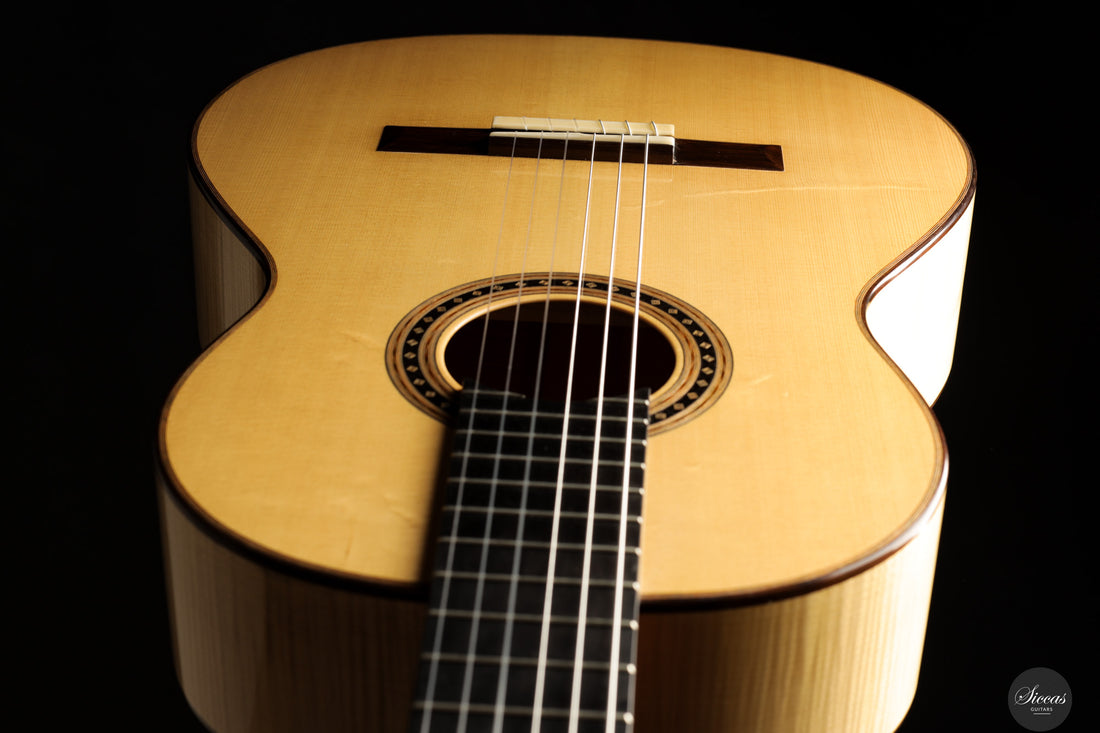
When should I upgrade to a concert guitar?
There is no particular grade or playing standard at which you must upgrade to a concert guitar. It becomes worth considering when another instrument offers something you value: greater sensitivity, more musical colour, a more comfortable feel or simply a sound you enjoy more.

Choosing a classical guitar scale length
Scale length is the nut-to-saddle length of the vibrating string. It sets the spacing of the frets and helps determine string tension, shaping how a guitar feels under the hands and contributing to how the complete instrument responds.

Cedar vs Spruce Classical Guitars: What Actually Changes?
Cedar and spruce have recognisable tendencies, but the better choice comes from the complete guitar: its response, character and what its maker has done with the wood.
Tell us what you currently play, what you would like to change and your approximate budget. We can help you decide what is worth comparing.