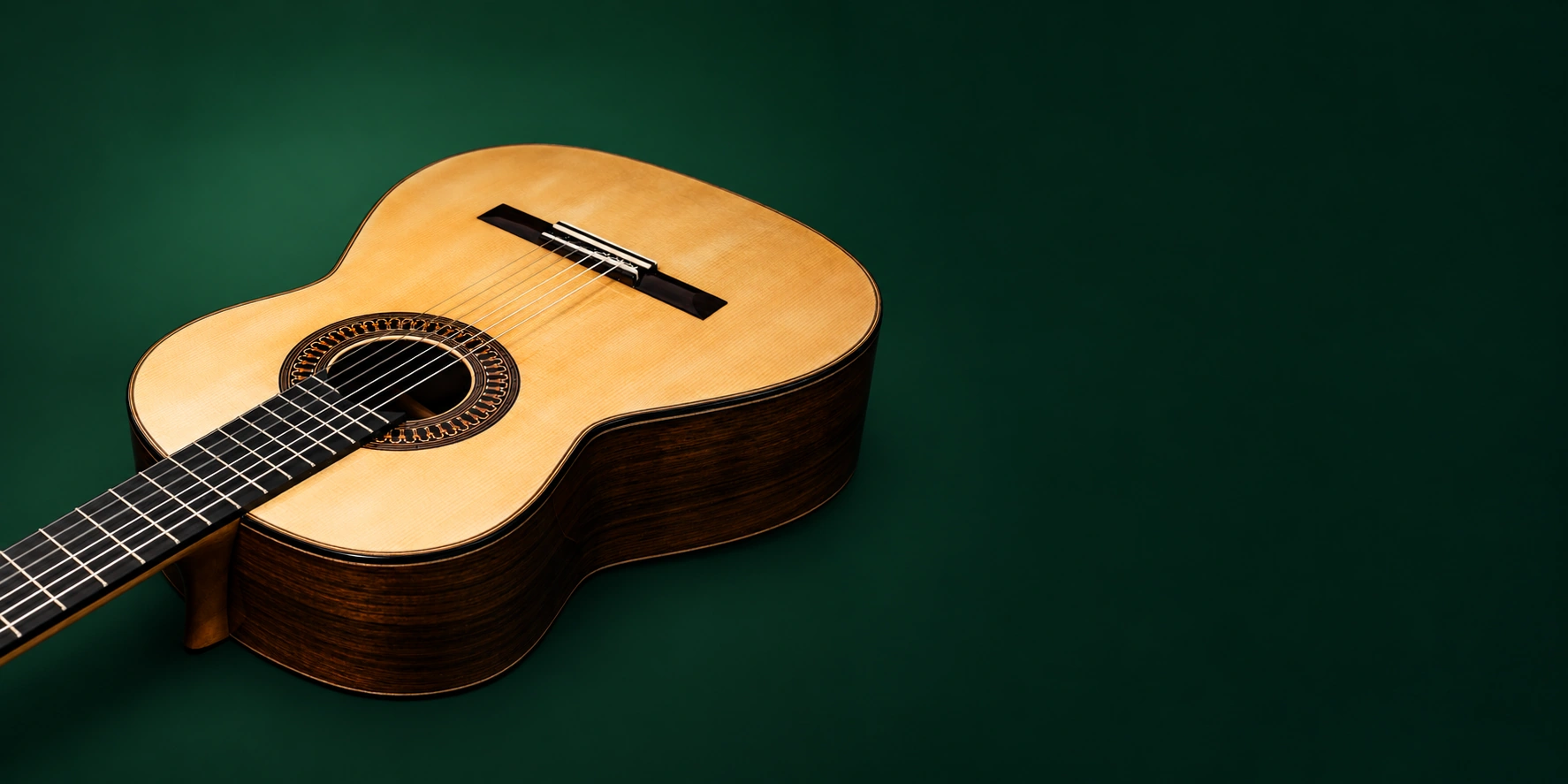
Choosing aclassical guitarscale length
Feel, tension, reach and sound
Scale length is the nut-to-saddle length of the vibrating string. It sets the spacing of the frets and helps determine string tension, shaping how a guitar feels under the hands and contributing to how the complete instrument responds.
Classical Guitar Academy
In the most basic sense, a guitar’s scale length is the length of the part of the string that vibrates when you play an open note: from the point where it leaves the nut to the point where it meets the saddle. A guitar described as having a 650 mm scale is therefore referring to a string length of about 650 mm, not the length of the neck or the size of the body.23
Makers use a nominal scale length to position the frets. The 12th fret sits halfway along that layout, so on a 650 mm scale it is 325 mm from the theoretical nut position. Doubling the nut-to-12th-fret distance is a useful way to understand—and usually check—the quoted scale length. The actual nut-to-saddle span can be slightly longer or differ from string to string because the saddle is adjusted for accurate intonation.316
That one measurement has two direct consequences. A shorter scale places the frets a little closer together, reducing the distance the left hand must cover along the fingerboard. It also requires less tension to bring the same kind of string to the same pitch. Those changes can affect reach, resistance and response under the hands.12
Tone is less direct. The string is only one part of a guitar, and body design, soundboard, bracing, bridge placement, setup and strings all contribute to the finished instrument. Scale length matters, but it cannot by itself predict whether a guitar will sound warm, clear, powerful or quiet.1112
The guide is organised in two parts. Part one explains the measurement, the numbers behind it and the range of scales used for concert guitars. Part two looks at the implications for playability and tone, then gives you practical steps for comparing guitars and choosing the scale that works for you.
Understand scale length
What the measurement means and where familiar concert-scale lengths sit.
What scale length actually measures
In everyday guitar descriptions, scale length refers to the length associated with the vibrating string between nut and saddle. For an accurate comparison, however, it helps to distinguish the nominal scale from the actual open-string span.23
The nominal scale is the design reference for the fret layout. On a conventional 650 mm layout, the 12th fret is 325 mm from the theoretical nut position: halfway along the nominal scale.
The actual open-string span runs between the points where the string leaves the nut and saddle. Those points may be adjusted for intonation, so the measured span need not be exactly 650 mm. Individual strings can also have slightly different spans on the same guitar.3
Why the saddle may not sit at exactly twice the nut-to-12th distance
Pressing a string onto a fret changes its geometry and tension. Real strings also resist bending. Makers use compensation—small adjustments to the nut or saddle contact positions—to reduce the resulting pitch errors.16
With an uncompensated nut, doubling the nut-to-12th-fret measurement is a useful way to check the nominal scale. It does not necessarily locate the actual saddle contact. A compensated nut can complicate that shortcut too, because its contact point may differ from the theoretical starting position.3
The practical lesson is simple: a small discrepancy in a tape measurement does not, by itself, show that a guitar is mislabelled or incorrectly built. Check the maker’s specification and compensation arrangement before drawing that conclusion.
A shorter scale is not necessarily a smaller guitar
Scale length does not specify body depth, neck thickness, nut width or string spacing. Those are separate dimensions, even when a maker changes several of them together.18
A 640 mm guitar may therefore answer a question about longitudinal reach without answering a question about how far your right arm reaches around the body. Ask which dimensions have actually changed, not just whether the guitar is described as “short scale” or “7/8”.
Is 650 mm the only proper concert scale?
No. Official maker specifications document concert-oriented instruments on both sides of 650 mm.456
| Nominal scale | Documented example | What the example establishes |
|---|---|---|
| 630 mm | Kenny Hill describes 630 mm instruments in his technical account | An established maker has used this length beyond beginner instruments |
| 638 mm | Ramírez Tradicional configurator | Makers do not restrict their choices to 10 mm increments |
| 640 mm | Hill documents 640 mm builds | Shorter scales have a place in concert-guitar making |
| 650 mm | Ramírez Tradicional and Steve Toon Double Top specifications | A widely used reference, not an exclusive standard |
| 660 mm | Steve Toon Double Top specification | Longer scales remain part of contemporary maker practice |
| 664 mm | Ramírez Tradicional configurator | The longer Ramírez tradition also remains represented |
Sources: official maker material. Hill’s account is dated 2011 and documents workshop practice, not present ordering terms. The Ramírez and Toon specifications were checked in September 2026. These are examples, not a stock list or a ranking.456
The history also resists a simple “long old guitars, shorter modern guitars” story. Amalia Ramírez describes the 664 mm José Ramírez III design and the introduction of the 650 mm C86 in 1986, followed by further redesign at 650 mm. Different lengths coexisted within the same workshop.11
For a buyer, the implication is that choosing a shorter scale need not mean choosing a lower category of instrument. Nor should a longer scale be treated as an upgrade in itself.
Scale length is a design choice, not an ability level.
Understand the impact on playability and tone
How the complete guitar feels and sounds—and practical steps for choosing the right scale for your playing.
How much difference does 10 or 20 mm actually make to reach?
On a conventional equal-tempered fingerboard, corresponding fret distances change directly in proportion to nominal scale. A 640 mm layout is approximately 1.54% shorter than a 650 mm layout.219
That does not mean a first-position stretch becomes 10 mm shorter. The reduction is distributed across the layout.
The difference in first position
| Nominal scale | Nut to first fret | First-to-fourth-fret span | Span difference from 650 mm |
|---|---|---|---|
| 630 mm | 35.36 mm | 94.61 mm | −3.00 mm |
| 640 mm | 35.92 mm | 96.11 mm | −1.50 mm |
| 650 mm | 36.48 mm | 97.61 mm | Reference |
| 660 mm | 37.04 mm | 99.11 mm | +1.50 mm |
Calculated from the conventional equal-tempered fret formula. Distances are between the theoretical nut position and fret centres, or between fret centres—not between fingertips in a particular chord. Figures are rounded to two decimal places.19
Moving from 650 to 640 mm therefore reduces the first-to-fourth-fret span by approximately 1.50 mm. Moving to 630 mm reduces it by approximately 3.00 mm. Higher up the fingerboard, the absolute difference becomes smaller: the 12th-to-15th-fret span is about 0.80 mm shorter at 640 than at 650 mm.19
Is that enough to matter?
The arithmetic cannot answer that for you. The research reviewed for this guide did not establish a universal threshold at which a scale change becomes noticeable or useful to a player.20
It would be just as unjustified to declare 1.50 mm irrelevant to everyone as to promise that it will transform everyone’s playing.
Your task is not to decide whether the number sounds impressive. It is to discover whether a particular guitar lets you do something you value more comfortably and reliably.
Try this: choose a familiar phrase containing the reach you find awkward, without forcing an extreme stretch. Play it at the same comfortable tempo on each guitar. Listen for the connection between notes and observe whether holding one finger causes another note to fail. Then return to the first instrument.
A repeatable improvement supports keeping that guitar on your shortlist. It does not prove that scale alone caused it. No clear improvement is a reason to investigate other differences before assuming you need a still shorter scale.
Does a shorter scale reduce string tension?
Yes, under stated conditions. For an ideal string at the same pitch and working mass per unit length, tension varies with the square of its vibrating length.1
“Mass per unit length” means how much string material there is in each unit of the working string. It is the relevant quantity in the equation—not the weight of the whole packet or the length left wrapped around the tuning roller.
The calculated tension difference
| Nominal scale | Ideal tension compared with 650 mm |
|---|---|
| 630 mm | 6.06% lower |
| 640 mm | 3.05% lower |
| 650 mm | Reference |
| 660 mm | 3.10% higher |
Assumptions: the same pitch and working mass per unit length, using nominal scale as vibrating length. These are ideal-string calculations, not measurements of a particular commercial set. Compensation, bending stiffness and changes in the working string are not included.19
Across the full range in this table, 660 mm requires about 9.75% more ideal tension than 630 mm. That comparison uses 630 mm as its starting point.19
For readers who want the calculation, the relationship is:
New tension ÷ original tension = (new length ÷ original length)²
For 640 versus 650 mm, that gives (640 ÷ 650)² = 0.969467…, or approximately 3.05% less tension.
Why the qualification about real strings matters
Research on nylon instrument strings shows that their stretching behaviour depends on time and previous loading. An identically labelled string at a different operating tension is not guaranteed to retain precisely the same working mass per unit length. The relevant 2025 experimental work studied nylon harp strings, so it should not be converted into a universal guitar-string settling timetable.17
The calculation remains useful. It tells us the expected direction and approximate size of the length effect under defined conditions. It does not justify four-decimal-place claims about the strings on a guitar in front of you.
Lower tension is not the same as less playing effort
A tension figure describes the pull along the string. Your left hand pushes it towards the frets; your right hand displaces and releases it. Those actions involve more than the resting pull.89
That is why “3% less tension” does not mean “3% easier to play”.
For the left hand: how far must the string move?
To stop a note, the string must contact the fret cleanly. Its initial clearance and the geometry of fretting matter alongside its tension. A 2024 classical-guitar intonation study explicitly treats changes in length, tension, mass per unit length and bending stiffness together rather than treating the string as an unchanged ideal object.16
The buying implication is that a guitar can feel demanding because of the distance the strings must travel, not merely because of the scale used to tune them. Our guide to classical guitar action explains this part of setup.
Compare the same barré low on the neck and farther up. Note whether the problem is general effort or one string that refuses to sound. That gives a more useful starting point for a setup discussion than “the strings are too tight”.
For the right hand: what kind of resistance do you prefer?
A string’s response to displacement depends on its span, tension and where it is plucked. Material and construction also affect its behaviour. Equal catalogue tensions therefore do not guarantee an identical experience under the fingers.89
Our practical recommendation is to test both ends of your musical range. Can you begin a quiet melody reliably? Can you increase intensity without unwanted buzz or an abrupt change in the response you want?
Do not assume that the lowest resistance is the most useful. The aim is not to win a contest for the softest-feeling strings, but to find a response that supports your playing.
The rest of the guitar may answer the real question
It is worth checking the variables around scale length before replacing an instrument you otherwise enjoy.
| Feature | What it changes or describes | A useful question |
|---|---|---|
| Nut width | Total fingerboard width at the nut | Does the neck feel too wide or too narrow? |
| Actual string spacing | Separation between strings, independently of the outer neck edges | Is the difficulty reaching across strings, or fitting fingers between them? |
| Neck profile and thickness | The shape and amount of material around which the hand works | Does the neck suit your hand in the positions you use? |
| Nut clearance | How far the strings must move near the nut | Is the difficulty especially noticeable in the first few positions? |
| Action, relief and fret condition | String clearance and its distribution along the fingerboard | Is effort or buzzing concentrated in particular places? |
| Body shape and support position | Where the guitar sits relative to your arms and hands | Is holding the instrument part of the difficulty? |
| Heel and fingerboard arrangement | Physical access around the body joint | Is upper-position playing restricted by access rather than fret spacing? |
This is a practical synthesis of setup, construction and teaching sources, not a ranking of which variable will matter most to every player.71518
Nut width and string spacing are not interchangeable
One documented Hill New Century guitar has a 51 mm fingerboard width at the nut, but 42.5 mm between its outer strings there. Its saddle string spacing is 57.5 mm. All three measurements describe different things.18
The implication is straightforward: “a 51 mm nut” does not tell you exactly how much room there is between strings. When that is the difficulty, ask for the spacing rather than relying only on the advertised width.
The 12th-fret action does not tell the whole setup story
Maker Michael Edgeworth’s setup account highlights the influence of string height at the nut, as well as action and fret condition. A guitar can warrant attention near the nut even when its 12th-fret action looks reasonable.7
Before rejecting a 650 mm guitar as too demanding, have those details assessed by someone competent in classical-guitar setup. Conversely, a suitable setup does not make a continuing reach problem imaginary: it simply helps separate one possible cause from another.
Lower action is not an unlimited improvement. Clearance must still accommodate the way you play, and the available saddle adjustment differs between instruments.7
Position is part of the comparison
Bradford Werner’s teaching guidance treats chair, support and guitar position as adjustable to the individual. This is practical teaching advice, not proof of one ideal posture for every guitarist.15
For a comparison, use a familiar support where possible and let each guitar sit sensibly. Record a helpful positional change rather than attributing its entire benefit to a shorter scale.
Two outcomes are equally legitimate: a setup or positional adjustment makes your existing guitar work better, or a different instrument remains preferable after those variables have been considered.
Can different strings compensate for a shorter scale?
They can compensate for a particular static tension value. They cannot make every other feature identical.
In the ideal model, matching the tension of a 650 mm string at the same pitch on a 640 mm scale requires approximately 3.15% more working mass per unit length. The figure is a calculation, not a recommendation for a packet labelled “high tension”.19
A replacement string might supply that extra mass through a different diameter, material or construction. Those changes can also alter stiffness and response. The shorter fret spacing remains shorter regardless.8
“High tension” is not an exact compensation setting
The manufacturer information reviewed does not support treating normal, medium and high as interchangeable numerical categories across brands. Even within one range, moving up a category need not increase every string’s tension by the same proportion.1020
Hannabach’s published 500-series figures illustrate the point. Calculated from its rounded values, the high-tension first string is approximately 7.14% above the medium version, while the sixth string is only 1.32% above. The change is not a uniform percentage across the set.10
The published page does not give a complete reference-scale, pitch and conditioning protocol. It is useful for showing differences within the stated range, not for constructing a precise cross-brand comparison from assumed test conditions.
What should you try?
First identify whether it is the treble response, bass response, left-hand effort or the whole set that you want to change. Record the make, range and tension of the strings already fitted, including any mixed strings.
Then change one thing at a time where practical and return to the same passages. An improvement with different strings may resolve the concern without changing the guitar; it may also reveal that the remaining issue is reach rather than resistance.
During a home trial, check the agreed conditions before restringing or adjusting an instrument. Do not file a nut or saddle as an experiment.
A useful string discussion with CGA Tell us which guitar and strings you use, what happens under each hand, and what you would like to change. “The bass feels loose in drop D” gives us a more specific question to discuss than “Should I use high tension?”
Should hand size, age or experience determine your scale?
Use those details to inform a conversation, not to generate a prescription.
The research reviewed for this guide did not establish a validated classical-guitar rule mapping hand span, height, age or sex to one correct scale. Hand measurements also leave out the musical task, instrument position and the rest of the guitar’s geometry.20
For smaller hands, our recommendation is to compare the actual reach that causes difficulty. For fingers that feel crowded, inspect cross-string spacing as well as longitudinal fret distances. These are different investigations, even though both may begin with “this neck does not fit”.
A beginner’s comparison can use simple notes, chord changes and a short melody. It need not include demanding repertoire. For a child, assess the whole instrument with the teacher, rather than using nominal scale or an age label as the sole decision rule.
An experienced player should have time to revisit familiar shifts and fingerings. Our suggested test is whether an obstacle persists after comfortable familiarisation, not whether every movement lands perfectly at the first attempt.
What does ergonomic research actually establish?
A 2022 study of 25 guitarists, 22 of them men, examined upper-body movement while sitting and standing and its associations with reported pain. It did not compare classical-guitar scale lengths. It cannot tell a particular reader to choose 630, 640 or 650 mm.13
That distinction matters: evidence about posture is not automatically evidence for a shorter guitar.
Do not use an instrument trial to test your tolerance of pain. Stop a test that provokes symptoms. Pain, tingling, weakness or reduced dexterity warrant advice from a qualified health professional, rather than a promise that a different scale will solve them. BAPAM also recommends a gradual return after a playing break, taking account of duration, intensity and difficulty.14
Two situations worth testing separately
Playing in drop D
Lowering the sixth string from E to D reduces its ideal tension by approximately 20.63%, assuming unchanged working mass per unit length. That is a much larger proportional change than moving from 650 to 640 mm. It applies to the lowered string, not to the entire set.19
For that reason, include your actual altered tuning in a trial. Test the bass at the dynamics you use, rather than judging only in standard tuning and assuming the result will carry across. String choice and available clearance belong in that discussion too.
Using a capo to explore shorter spacing
On a nominal 650 mm scale, a capo at the first fret leaves approximately 613.52 mm of speaking length. Without retuning, however, it also raises the pitch while leaving tension approximately unchanged, apart from the capo’s own fretting action.19
This is not equivalent to a purpose-built 613.5 mm guitar tuned to ordinary E–E. It changes the starting point on the neck and does not reproduce another instrument’s nut, body or access arrangement.
A capo can be an exploratory way to experience closer fret spacing. It is not a conclusive short-scale feel or sound test.
Would a shorter scale mean sacrificing sound?
There is no reliable universal rule that ranks completed classical guitars by scale length alone.
The research reviewed for this guide did not locate a controlled body of evidence establishing that longer-scale classical guitars consistently project better, independently of construction, strings and setup. That is a limit of the evidence found—not proof that scale has no acoustic influence.20
The string is only part of what you hear
String vibration passes through the bridge into the body. The soundboard and coupled body-and-air behaviour are central to the sound reaching a listener. Static tension is therefore not a direct measure of acoustic output.12
The maker may also alter bridge placement, soundboard construction, bracing or body dimensions when designing around a different scale. Comparing those completed instruments can reveal which you prefer, but not isolate what the scale contributed.11
There is another complication: “the same attack” can mean the same plucking force, the same string displacement or the same musical intention. Those are not interchangeable physical conditions. The mechanical calculations behind this guide show why changing that comparison can change the energy result.19
What do makers report?
Kenny Hill’s account of his own instruments describes successful 640 mm guitars without the presumed loss of volume. That is relevant workshop experience, but the account does not provide a controlled listening protocol establishing a universal result.5
Amalia Ramírez describes reduced projection in the smaller-bodied 650 mm C86, then improved projection after further design changes while retaining 650 mm. Her account concerns a developing guitar design, not an experiment changing scale alone.11
These observations need not contradict each other. They concern different constructions and comparisons. Neither justifies turning “shorter” or “longer” into a guarantee of warmth, clarity, sustain or concert power.
Ask a musical question, then listen for the answer
For a buyer, the useful question is not “Which scale is loudest?” but “Can this instrument deliver the sound and dynamic range I need?”
We suggest listening for a melody over its accompaniment, the beginning and decay of quiet notes, and what happens when the music asks for greater intensity. Have someone else play while you listen farther away, in the same room and from the same position for each guitar.
A preference for one instrument is enough to support a buying decision. You do not need to prove which construction detail caused it.
Define what you would like to improve
Before deciding that you need 630, 640, 650 or 660 mm, describe the problem without using a measurement.
“I struggle to reach the notes.” Start with the particular fingering and passage. Is the difficulty along the fingerboard, across the strings, or in getting the hand around the neck?
“I can reach everything, but playing takes too much effort.” Look closely at stopping the strings, barrés and how the guitar responds under each hand. Reaching a note and pressing it cleanly are different tasks.
“The guitar feels cramped, awkward to hold, or difficult above the body.” Investigate spacing, neck shape, body fit and access rather than assuming that a longer or shorter scale will address them.
These are diagnostic questions, not a sizing formula. Setup practice and the mechanics of fretting give us reasons to investigate several variables independently; they do not provide a single measurement of how easy a complete guitar will feel.716
Our recommendation is to write down one priority before comparing instruments. “I want to connect these notes without disturbing the bass” is a more useful test than “I want a smaller guitar”.
A useful starting point with CGA Tell us what you like about your current guitar as well as what you would change. Bring the relevant music—or identify a few bars—so the conversation can start with your playing rather than a presumed specification.
How to compare two guitars usefully
- 01Choose priority questions
- 02Record the instruments
- 03Play the same material
- 04Tune, pause and repeat
- 05Listen from the other side
- 06Allow more than one outcome
The following is CGA’s suggested buying-comparison method, not a laboratory experiment or a clinical assessment. Its purpose is to make observations clearer and help you decide what matters.
1. Choose two or three priority questions
Write down what a successful comparison would resolve. For example: connecting a first-position phrase, playing a barré cleanly without excessive effort, or keeping a quiet treble line clear.
Use achievable musical tasks. Do not invent an extreme stretch simply to make one guitar fail.
2. Record the instruments you are actually playing
Note nominal scale, nut width, string spacing and the neck’s shape. Record the strings and their condition, the tuning, and relevant setup details. Ask for help with measurements you cannot take reliably.
Where something is unknown, leave it unknown. Do not borrow a specification from another example of the same model.
There are two valid comparisons: choosing between complete guitars as offered, or trying to investigate a scale effect. Different strings can be part of the first comparison. They are a complication in the second. Be clear which question you are asking.
3. Play the same material on each
Use the same fingering, comfortable tempo and musical intention initially. A later change of fingering may be useful, but record it as a change rather than crediting the guitar alone.
| Test | What to play | What to observe |
|---|---|---|
| Reach | A familiar phrase with a relevant extension | Whether notes connect without disturbing another finger |
| Barrés and slurs | A low-position and mid-neck chord; a short slur group | Clean notes, effort and whether the same string or region causes difficulty |
| Shifts and upper positions | A familiar movement up and back down the neck | Accuracy after familiarisation, heel access and finger crowding |
| Quiet response | A soft melody or arpeggio | Reliable note beginnings, separation and contact noise |
| Stronger playing | The same phrase with gradually greater intensity | Useful response, buzz and unwanted changes in sound |
| Altered tuning | Your actual drop-D or other relevant passage | Bass control, clearance and tuning response |
A simple two-bar passage that answers your question is more useful than an impressive performance that does not.
4. Check tuning, then pause and repeat
Tune both guitars carefully and recheck during the comparison. Listen to chords in several positions. Treat persistent discrepancies as a reason to investigate strings, pressure, setup and compensation—not as proof that a nominal scale is wrong.16
Return to the first guitar after the second. Take a break before fatigue becomes part of the judgement, and repeat important tests in a later session where possible.14
Write specific observations: “the upper note stayed clear while I held the bass” is more useful than “easier”. Record what did not improve as well.
5. Listen from the other side of the guitar
Ask someone else to play the same material while you listen from a consistent position. Include quiet music and sustained phrases as well as stronger passages.
For recordings, our recommendation is to keep microphone position and settings consistent and note any automatic level processing. Treat recordings as one source of information, not a substitute for the playing comparison.
6. Make a decision that allows more than one outcome
Choose a different guitar when the benefit repeats, matters to your music, and does not involve a trade-off you find unacceptable.
Keep investigating setup or strings when the problem appears to be stopping effort, clearance or a particular string’s response rather than reach.
Keep your current guitar when a manageable adjustment addresses the difficulty and you still enjoy the instrument. An inconclusive result can remain inconclusive; there is no need to turn it into a rule about millimetres.
The goal is not a guitar that wins every possible test. It is an instrument that serves your priorities well.
Conclusion
Scale length is worth understanding because it changes real, measurable things. It is not worth allowing those measurements to make the decision before you play.
A closer fret layout is a reason to investigate a shorter instrument. A preferred resistance is a reason to compare strings and setup alongside length. A wish for greater presence is a reason to listen carefully to completed guitars, not to buy from a scale specification alone.
The best outcome may be a shorter guitar, a longer one, another instrument at the same scale—or a better experience with the guitar you already own.
Choose for a repeatable musical benefit. Use scale length to help explain the result, not to predetermine it.
Bring the passage, not just a preferred scale
You do not need to arrive at CGA with a measurement already chosen. Tell us about your current instrument, the music you enjoy, and what you would like to improve. We can use that as the starting point for discussing suitable guitars and a useful comparison.
Arrange an appointment or contact CGA about a particular instrument, and let the playing lead the decision.
How this guide was prepared
This guide draws on musical-acoustics research, university resources, official maker and string-manufacturer information, and performing-arts-health guidance. AI-assisted research and drafting were used. Calculations are identified separately from measurements; maker accounts are attributed as workshop observations rather than controlled trials.
The comparison method is practical buying guidance, not a validated test of comfort or health. The underlying literature search was a narrative review, not a systematic review. Statements that evidence was not located describe that search; they do not establish that no such evidence could exist.
Sources and calculation notes
- 1
Joe Wolfe, “Strings, standing waves and harmonics”, UNSW School of Physics, Music Acoustics, undated. See the string equations and discussion of real-string effects. Read the university resource.
- 2
Gabriele U. Varieschi and Christina M. Gower, “Intonation and Compensation of Fretted String Instruments”, American Journal of Physics 78, 47–55 (2010). DOI: 10.1119/1.3226563. See Section II.1 for fret placement; the experiments used sonometers, not player preference tests. Read the author manuscript.
- 3
Gregory Byers, “Intonation”, undated technical account drawing on his 1995 lecture and 1996 American Lutherie article. See “Fret Placement”, “Optimization” and the string-specific compensation discussion. Read the maker’s account.
- 4
Guitarras Ramírez, “Tradicional (1A)”, official specification and configurator. Scale choices checked September 2026: 638, 650 and 664 mm. View the specification.
- 5
Kenny Hill, “Tech Notes: Short Scale 640, 630, 615”, 1 January 2011. A firsthand maker account; its historical ordering terms are not represented here as current availability. Read the technical note.
- 6
Steve Toon, “Double Top Classical Guitar”, official specification, checked September 2026. Lists 650 or 660 mm, or by request. View the specification.
- 7
Michael Edgeworth, “Classical Guitar Setups”, 10 November 2024. Maker’s explanation of action, nut clearance, frets and adjustment limits. Read the setup account.
- 8
Jim Woodhouse, “7.2 Choosing strings”, Euphonics, undated. Explains string mass, stiffness, impedance, damping and aspects of feel. Some examples use other instruments or idealised models. Read the technical explanation.
- 9
R. M. Mottola, “Human Perception of String Tension and Compliance in Stringed Musical Instruments”, updated 13 July 2025. Technical discussion, including nonclassical and informal examples; not a validated classical-guitar perception threshold. Read the discussion.
- 10
Hannabach, “500”, official medium/high tension table, checked September 2026. First-string values: 7.0 and 7.5; sixth-string values: 7.6 and 7.7, in the maker’s “kg” labelling. Percentage differences in this guide are calculated from those rounded figures; the page does not provide a complete test protocol. View the table.
- 11
Amalia Ramírez, “The C86 Guitar”, posted 28 September 2023; text signed 1 September 2023. Workshop history, including simultaneous changes in body design and scale. Read the account.
- 12
UNSW School of Physics, “How a guitar works”, undated. Explains the role of the strings, bridge, soundboard and body/air interaction. Read the university resource.
- 13
Sigal Portnoy, Shlomit Cohen and Navah Z. Ratzon, “Correlations between body postures and musculoskeletal pain in guitar players”, PLOS ONE 17(1), e0262207 (2022). DOI: 10.1371/journal.pone.0262207. See Participants, Procedure and limitations; this was not a scale-length intervention. Read the study.
- 14
British Association for Performing Arts Medicine, “Returning to Playing and Performance for Instrumental Musicians”, last reviewed October 2024. Guidance on gradual return, symptoms and individual assessment—not evidence that a scale length prevents injury. Read the guidance.
- 15
Bradford Werner, “Classical Guitar Position Lesson”, 2023. Teaching guidance on chair, support and instrument position. Read the lesson.
- 16
M. B. Anderson and R. G. Beausoleil, “Classical guitar intonation and compensation: The well-tempered guitar”, Journal of the Acoustical Society of America 156(1), 683–705 (2024). DOI: 10.1121/10.0026483. See the model, measurements and compensation procedure. Read the paper.
- 17
Nicolas Lynch-Aird, Jim Woodhouse and Claire Y. Barlow, “Plastic Creep Constraint in Nylon Instrument Strings”, Materials 18(2), 223 (2025). DOI: 10.3390/ma18020223. Experimental nylon-harp-string evidence; no universal guitar settling time is inferred here. Read the Cambridge repository record.
- 18
Hill Guitar Company, “4276 New Century Model”, official specification for a 2023 instrument marked sold. Documents scale, fingerboard width, string spacing and body dimensions separately. View the instrument record.
- 19
Original calculations for this guide, independently recomputed from the stated models. Ideal tension:
T = 4 × L² × f² × μ, with length in metres, frequency in hertz and working linear mass density in kg/m. Fret distance from the theoretical nut:x(n) = L × [1 − 2^(−n/12)]. First-to-fourth span:L × [2^(−1/12) − 2^(−4/12)]. Tension-matching mass ratio at 640 mm:(650/640)². Drop-D tension ratio:2^(−4/12). First-fret capo span on 650 mm:650 × 2^(−1/12). For small sideways displacement at a fixed fractional position α,k ≈ T/[L × α × (1−α)]; energy at fixed displacement isU ≈ ½ky², while at fixed force it isU ≈ F²/(2k). These model results do not predict the complete guitar’s loudness or a player’s effort. Supporting numbers are supplied in the accompanying calculation file, reproducible withverify_calculations.py. - 20
Research scope and evidence limits. The preparatory CGA scale-length research dossier (14 September 2026), especially Sections 7.5, 8.3 and 14, did not locate controlled evidence establishing a universal acoustic ranking by scale, a universal perceptual threshold, or a validated demographic sizing rule. It also records gaps in manufacturer test-condition information. These are search-limited conclusions, not assertions that relevant evidence cannot exist. The accompanying dossier is the research record, rather than an external peer-reviewed source.