
What defines a concert guitar?
A concert guitar is a high-quality classical guitar built to meet the musical demands of professional performance. Compared with a typical studio guitar, you should expect a more refined sound, stronger projection and greater expressive range, supported by carefully selected materials and excellent craftsmanship.
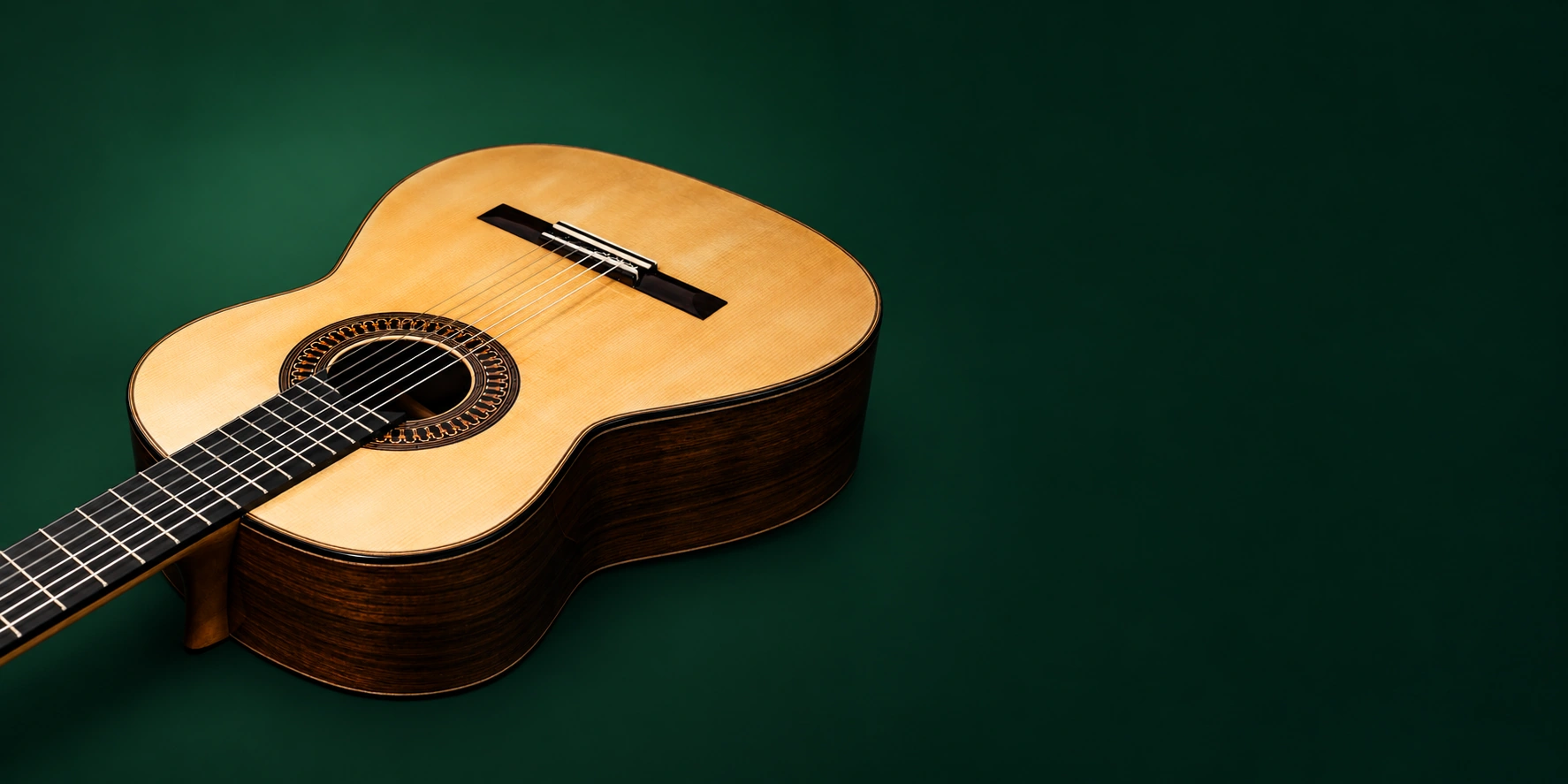
Its defining qualities go beyond the specification sheet. What matters is how these elements come together in the finished instrument: whether it gives a melody substance, keeps musical lines clear and responds to the changes you make with your hands.
The six qualities below offer a useful way to listen and compare. Makers pursue them through different construction methods, and players place different emphasis on each. A guitar can be a convincing concert instrument without having the same voice or feel as another.
Materials and craftsmanship
Fine tonewoods are selected for their acoustic qualities and suitability for the instrument. Precise construction, careful finishing and attention to detail are equally important: the quality lies not just in the materials, but in the skill with which they are shaped and assembled.
The soundboard deserves particular attention. In his discussion of selecting a top, John Bogdanovich considers the wood’s stiffness, density and grain orientation, and how its properties suit the maker’s approach. He also explains that visual uniformity and close grain spacing are not reliable substitutes for assessing the material itself. A handsome piece of wood and an acoustically useful one are not necessarily the same thing.[1]
Species names are useful context, but they do not tell you exactly how a guitar will sound. Hill Guitar Company cautions that familiar descriptions of spruce as bright and cedar as warm are generalisations, with exceptions in individual instruments. Listen to the finished guitar rather than treating either soundboard wood as a guaranteed result.[2]
Construction can also take different forms. A traditional solid soundboard is supported by internal braces; a double top uses a layered structure. Thomas Ochs describes his double tops as thin wood skins surrounding a Nomex honeycomb core, with the aim of reducing weight while maintaining stiffness. He uses this approach to work towards a quicker response, stronger projection and a wider dynamic range.[3]
For the player, the useful question is how well the workmanship serves the music. Look for a carefully finished instrument, then play it across the fingerboard. Decorative detail can add pleasure to ownership, but it cannot tell you whether the guitar has the balance, response and comfortable feel you need.
Projection / Volume
A concert guitar will generally offer more volume and carry its sound more effectively across a room. The benefit is not simply louder playing, but more room to shape phrases, create dynamic contrast and build towards a musical climax.
It helps to distinguish the sound you hear while playing from the sound reaching a listener. In his evaluation guide, Sebastian Stenzel explains that the balance heard behind a guitar can differ considerably from the balance in front of it. He recommends listening to another person play, while remembering that their touch will also influence the sound. A powerful impression under your ear is therefore only part of the picture.[4]
When comparing guitars, ask someone to play the same short passage on each while you listen from several metres away. Choose a melody with accompaniment rather than only a loud chord. Can you still follow the tune easily? Are the bass notes distinct? Does the phrase remain clear as the player becomes quieter? These observations are more useful than deciding which guitar makes the biggest initial sound.
Dynamic range matters alongside projection. Start a familiar phrase gently, then repeat it with progressively more energy. Listen for whether the stronger playing adds body and musical intensity while preserving clarity. At the quiet end, notice whether the notes speak readily enough for you to shape the phrase without forcing them.
Construction labels alone cannot settle this comparison. Dominik Wurth explains that a double top’s weight and the construction of the rest of the body matter to the result; he notes that some double tops are no louder than traditionally built guitars. A description of the design therefore cannot replace hearing what an individual instrument actually does. Compare the guitars in the same room wherever possible.[5]
Core tonal quality
The underlying tone should be rewarding even when you play a simple melody. Trebles should have substance and a singing quality, rather than sounding thin or plasticky, while the basses should offer depth without losing definition. This quality of sound is valuable in its own right, before you begin exploring the instrument’s expressive possibilities.
In an interview published on his own website, Sebastian Stenzel describes the importance of a beautiful voice with body, together with transparency and balance across the strings and frets. He connects those qualities with the ability to hear separate musical voices clearly. This offers a useful way to judge refinement: listen for a sound that is full and appealing while allowing the music’s detail to remain audible.[6]
In practice, listen through the whole life of a note. Is its beginning clear? Does it settle into a pleasing sound after the initial attack? Does it last long enough for the phrase you are playing? A note that impresses for a moment may be less satisfying when you need to sustain a melody over changing accompaniment.
Balance is equally important. Play a slow scale across several strings and into higher positions, listening for abrupt changes in fullness or response. Then try a passage with a melody, bass and inner voice. You should be able to hear their separate roles without the bass overwhelming the treble or the accompaniment obscuring the tune.
These listening checks leave room for preference. You may enjoy a focused, direct voice or one with more resonance around each note. Refinement does not require every guitar to sound alike; it asks whether the character you enjoy remains convincing across the music you want to play.
Tonal palette
Beyond an attractive basic sound, a concert guitar should allow you to vary its character: warm and rounded, bright and direct, delicate or full. Changes in your touch should produce meaningful differences, giving you more ways to shape the music rather than one appealing sound.
Colour and loudness are related, but useful to explore separately. Play a short melody closer to the bridge, then nearer the fingerboard, keeping its volume as similar as you can. Next, stay in one area and vary the angle and character of your contact with the string. Listen for changes that you could use deliberately in a phrase.
Kenny Hill describes his double-top instruments as giving him flexibility in both volume and tone colour, with a response that follows his musical intentions. He also acknowledges the appeal of traditional solid tops and treats the choice between fan and lattice bracing as a matter of difference and personal preference. These are observations about his own designs, rather than a rule that one construction has the widest palette.[7]
Try giving a repeated phrase two distinct characters: a softer, more intimate opening followed by a brighter answer. A useful palette lets the change feel intentional and repeatable. The aim is to find colours you enjoy and can control, including at the quieter dynamics where subtle phrasing often happens.
Playability
Careful neck shaping, fretwork and setup will often make a concert guitar more comfortable to play, while a sensitive response can reward a lighter touch. Comfort remains personal, however: the neck profile, dimensions and setup still need to suit your hands and playing style.
Action—the height of the strings above the frets—is one part of that balance. Strings set too high can make fretting unnecessarily demanding; strings set too low may buzz or strike the fingerboard during stronger playing. Bogdanovich explains how neck geometry, the nut, saddle and level frets work together to provide the necessary clearance. He also notes that setup problems can occur on expensive instruments.[8]
For that reason, a concert guitar need not have the lowest possible action. It needs a setup that allows your playing to feel comfortable and sound clean through the dynamic range you use. If a guitar appeals to you but feels too stiff or buzzes under your normal touch, ask what a suitable adjustment could achieve before making a judgement about the instrument.
Fit extends beyond action. Scale length, string spacing, neck shape and body size affect how an instrument sits in your hands and against your body. Michael Thames documents a 640mm version of his Torres La Leona replica, with a modern adjustable bridge arrangement. This is a concrete example of a maker adapting a historical classical design; a shorter scale is an option worth comparing when reach and comfort are priorities.[9]
Some designs also address particular playing demands. Kenny Hill describes an elevated fingerboard for easier access above the twelfth fret, alongside a tapered body and an armrest intended to improve how the guitar sits against the player. Treat features like these as options to try against your own repertoire and playing position, rather than requirements for every concert guitar.[7]
During a trial, include first-position chords, a barré, a stretch and a passage higher up the neck. Spend enough time playing for the initial unfamiliarity to settle. Notice both the effort in the left hand and how readily the right hand produces the sound you want; a comfortable instrument should suit the way both hands work.
Performance quality
Although capable of professional concert use, these instruments are equally rewarding for practice and enjoyment at home. Many players choose them simply because they appreciate a beautiful sound and a more satisfying playing experience.
The benefits discussed here also matter in a quiet room. A sustaining treble can make a slow melody more rewarding; clear separation can help you hear the balance of an arpeggio; an expressive response gives you more possibilities when repeating a phrase. You can enjoy those qualities in music you already know, then learn to use them more fully over time.
The purchase remains a personal decision. Hill Guitar Company describes its aim as finding an instrument that suits each player’s overall needs, and emphasises that every guitar is different. That is a helpful starting point for an amateur as well as a performer: identify the sound and feel you value, then compare what the actual guitars offer.[2]
You do not need an audience to enjoy what a fine guitar offers. Nor do you need to replace a guitar that already makes you happy. A concert instrument is worth considering when its combination of sound, expression and comfort gives you something you would enjoy having—and the purchase fits comfortably within your budget.
References
These references link to established makers’ own explanations of their materials, designs and setup. Their comments describe their approaches and experience; the listening suggestions above are practical ways to explore the qualities discussed.
- John S. BogdanovichThe Soundboard
- Hill Guitar CompanyFrequently asked questions
- Thomas OchsDouble-top construction
- Sebastian StenzelTips for the Evaluation of Classical Guitars (PDF)
- Dominik WurthDouble Top Guitar (Nomex)
- Sebastian Stenzel, interviewed by Greg HansonInterview in American Lutherie, 2000 (PDF)
- Kenny HillNew Golden Era: features and options
- John S. BogdanovichGuitar Set Up
- Michael ThamesTorres La Leona replica: a 640mm example
Keep exploring
Read more about choosing a classical guitar, then explore the instruments currently available at CGA.
When should I upgrade to a concert guitar?
There is no particular grade or playing standard at which you must upgrade to a concert guitar. It becomes worth considering when another instrument offers something you value: greater sensitivity, more musical colour, a more comfortable feel or simply a sound you enjoy more.

Cedar vs Spruce Classical Guitars: What Actually Changes?
Cedar and spruce have recognisable tendencies, but the better choice comes from the complete guitar: its response, character and what its maker has done with the wood.

Choosing a classical guitar scale length
Scale length is the nut-to-saddle length of the vibrating string. It sets the spacing of the frets and helps determine string tension, shaping how a guitar feels under the hands and contributing to how the complete instrument responds.
Tell us what you currently play, what you would like to change and your approximate budget. We can help you decide what is worth comparing.