
Studio vs concert guitars
CGA sells mid to high-end studio guitars: fully checked, approved instruments that CGA recommends to its own pupils. Choosing between studio and concert guitars means finding the sound, feel and musical possibilities you enjoy, within a budget you are comfortable spending.

Both categories deserve serious consideration. A studio guitar can be a rewarding companion for many years; a concert instrument may offer particular refinements you value in practice, at home or on stage.
What the categories mean
At CGA, studio guitars sit between entry-level instruments and the full concert collection. They are serious, budget-conscious choices for developing players and committed amateurs, selected for musical quality, response and comfortable playability. They offer room to grow, and need not be a temporary purchase.[1]
What defines a studio guitar? looks more closely at the qualities to expect.
Our concert guitars focus on further refinement, sensitivity, projection and expressive range. Traditional, modern and historically inspired designs can all belong here. The term describes musical ambition and capability; it does not restrict ownership to professional performers.[2]
Terminology varies between makers: ‘studio’, ‘estudio’, ‘conservatory’ and ‘concert’ are not universal standards. CGA’s categories help organise a shortlist, while each listing describes the individual instrument. What defines a concert guitar? explores those qualities more closely.
The musical qualities in common
An attractive core sound, clear musical lines and a willing response matter in both categories. A good studio guitar can have singing trebles, resonant basses, useful tonal variety and enough projection for the music and setting you have in mind. It should make careful practice more rewarding, rather than merely tolerate it.
The table describes tendencies, with considerable overlap. It cannot predict which of two guitars you will prefer.
| Quality | CGA studio guitars | CGA concert guitars |
|---|---|---|
| Materials and craftsmanship | Carefully built instruments; workshop methods and materials vary. | Often more individual work and material selection; execution matters more than prestige. |
| Core sound | An appealing, balanced voice with musical substance. | May offer finer balance, greater depth or more sustained trebles; character remains personal. |
| Projection | Can carry clearly in lessons, ensembles and suitable performance spaces. | Often more carrying power and clarity at distance; check the actual room and guitar. |
| Response and dynamics | Can respond readily and offer satisfying quiet-to-strong contrasts. | May follow subtler touches and retain clarity over a wider dynamic range. |
| Tonal palette | Useful contrasts of warmth, brightness and articulation. | Potentially more nuanced colours and harmonic complexity, depending on the design. |
| Playability | Comfortable setup and proportions are central to selection. | Fine fretwork and response can help; comfort still depends on fit and setup. |
| Intended use | Serious study, home enjoyment, ensemble playing and performance. | Specific performance demands, detailed musical exploration and enjoyment at home. |
| Investment | Usually a smaller outlay; potentially a satisfying long-term choice. | Usually a larger outlay; worthwhile when its particular benefits matter to you. |
Where refinement can go further
A concert instrument may reveal smaller changes of touch, sustain a melody more convincingly or keep closely spaced voices distinct. Its tonal complexity might lend depth to a slow phrase; a wider expressive range can give repeated material noticeably different characters. These benefits are worth hearing in music you actually play.
Projection means more than immediate loudness. A guitar may carry a clear melody across a room while leaving its accompaniment in proportion. Greater dynamic headroom can let you build a climax without the sound becoming strained, while sensitivity at the quiet end helps delicate notes speak. Neither property is exclusive to concert guitars.
Further refinement is useful when you enjoy and can draw on it. It may be subtle, and a more complex voice is not automatically your favourite. A direct studio sound can suit your musical taste better than a highly resonant concert instrument.
Listen beyond the label
Construction tells you how a maker approaches the instrument, not how successfully it will meet your needs. CGA’s studio Antonio Picado Model 60DT (2023) has a spruce soundboard and a layered rosewood/cedar back. Steve Toon’s concert Cedar Doubletop (2025) instead uses a Nomex-core soundboard. The similar names refer to different parts of the guitar; ‘DT’ alone cannot settle a comparison.[4][5]
Wood species are clues, too. Cedar or spruce? explains why familiar tonal descriptions need qualification. Decorative rosettes and striking timber may give pleasure, but do not establish sound quality. Price reflects many factors, including labour, materials and condition; it is context rather than a verdict.
In a Savart Journal study, seven classical-guitar students compared twelve instruments. There was broad agreement at the most and least favoured ends, but substantial disagreement elsewhere: one guitar received both highest and lowest rankings. Measured frequency responses showed no clear correlation with the subjective ratings. This small, non-blinded study did not compare CGA’s categories or establish that price is irrelevant. Its practical lesson for this guide is to judge the actual guitar, allowing for individual preference.[3]
Choose for your musical life
For lessons and practice, prioritise a sound you can shape and a comfortable instrument you want to pick up. At home, quiet response and an enjoyable voice may matter more than maximum carrying power. In an ensemble, try the balance and clarity against other instruments. For performance, consider the room, repertoire and whether amplification is available.
A developing player seeking a meaningful improvement might choose a studio guitar with clearer melody notes and easier fretting, leaving money for lessons. Identify what needs to improve using When should I upgrade to a concert guitar?, then compare against your present instrument.
An amateur playing mainly for enjoyment might keep a studio guitar whose voice feels right, or choose a concert guitar because its colours make favourite pieces more satisfying. You do not need to earn a fine instrument through a particular playing standard.
A performer might seek a sustained upper-register melody, precise quiet attacks or clearer projection in a hall. A concert shortlist may help, but the purchase should answer those specific needs. Choose a comfortable spending limit first; a smaller outlay that meets your musical priorities is a successful decision.
Compare the actual guitars
Allow time for unfamiliar instruments to settle into your hands before judging them. Neck shape, action, string spacing and scale length affect fit in either category. For example, CGA records a 640mm scale for both the studio Jellinghaus Torres FE17 1A and the concert Torres FE13. The category alone does not determine reach or comfort.[6][7]
- Keep conditions comparable. Use the same room, chair, support and tuning; note differences in string type, age and setup. Compare a small shortlist, with breaks to keep your ears fresh.
- Play familiar passages. Include a slow melody, an arpeggio with separate voices, a barré and a higher-position phrase. Listen for balance and sustain while noticing effort and comfort.
- Vary the expression. Repeat a phrase quietly and strongly, then change right-hand position and attack. Notice whether colours and dynamics are useful, controllable and pleasing to you.
- Listen from a distance. Ask another player to repeat the same passages on each guitar while you sit several metres away. Their touch affects the result, but you can hear how the melody and accompaniment carry.
- Return to your favourites. Give each adequate playing time, revisit your current guitar and write down what improved. Ask whether any setup adjustment is realistic before dismissing an otherwise appealing instrument.
Choose the guitar that makes your music more satisfying at a cost you can comfortably accept. That may be a studio instrument you keep for years, or a concert guitar whose particular refinement you love. Either can be the right destination.
Sources and references
Category descriptions and individual specifications were checked against CGA’s records and original product listings. The Savart study informs the discussion of preference; the practical recommendations are this guide’s interpretation.
- Classical Guitar AcademyStudio guitars
- Classical Guitar AcademyConcert guitars
- Mark French, Laura Lydy and Miles CrawfordComparing Subjective and Objective Data from a Pool of Classical Guitars — Savart Journal (2019)
- Classical Guitar AcademyAntonio Picado Model 60DT (2023): studio category, spruce top and layered back
- Classical Guitar AcademySteve Toon Cedar Doubletop (2025): concert category, Nomex-core top and 640mm scale
- Classical Guitar AcademyWolfgang Jellinghaus Torres FE17 1A: studio category and 640mm scale
- Classical Guitar AcademyWolfgang Jellinghaus Torres FE13: concert category and 640mm scale
Photograph: Classical Guitar Academy.
Keep exploring
Read more about choosing a classical guitar, then explore the instruments currently available at CGA.
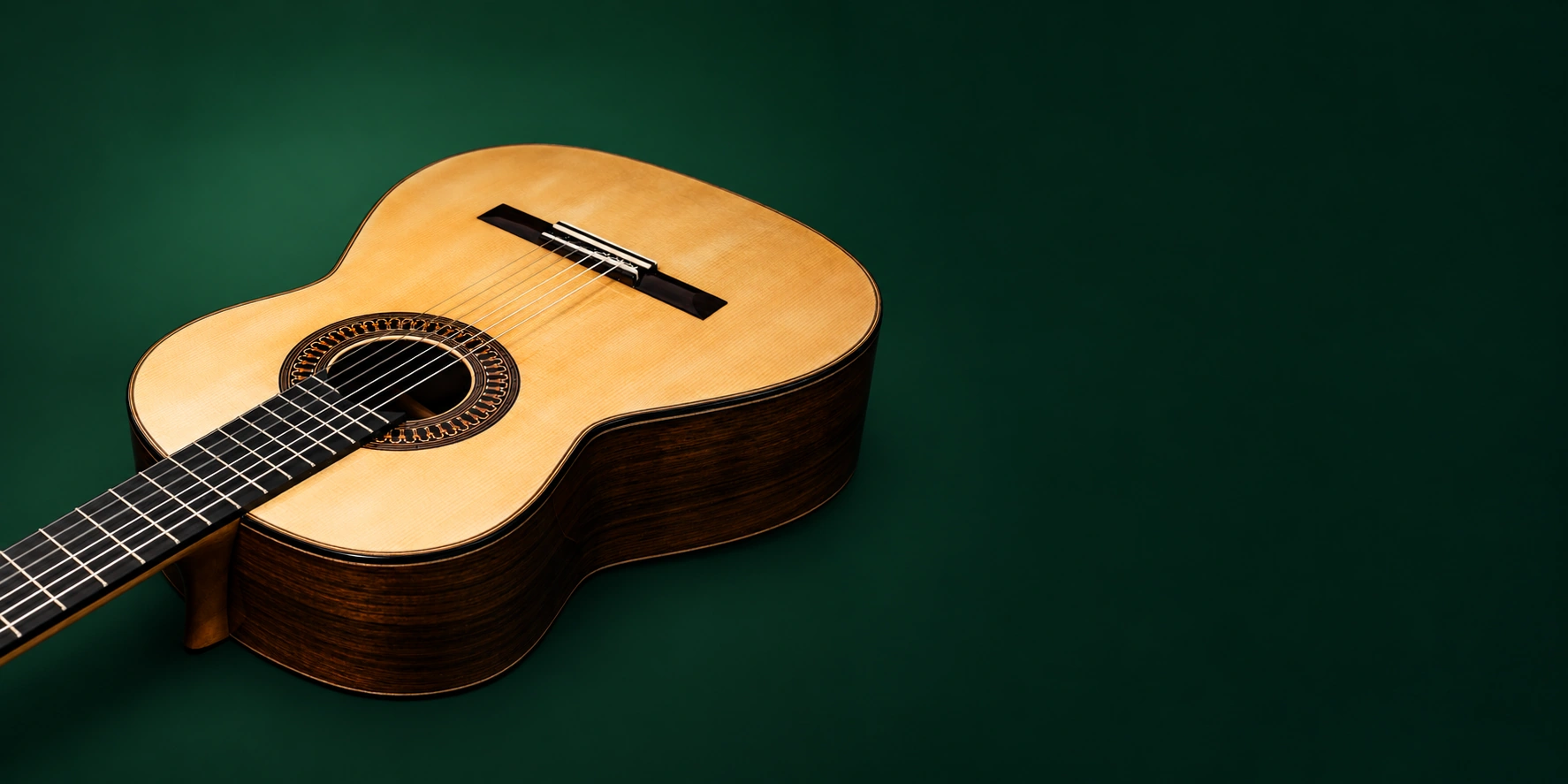
What defines a concert guitar?
Explore the materials, craftsmanship, projection, refined sound, tonal colours and playability that define a concert classical guitar.
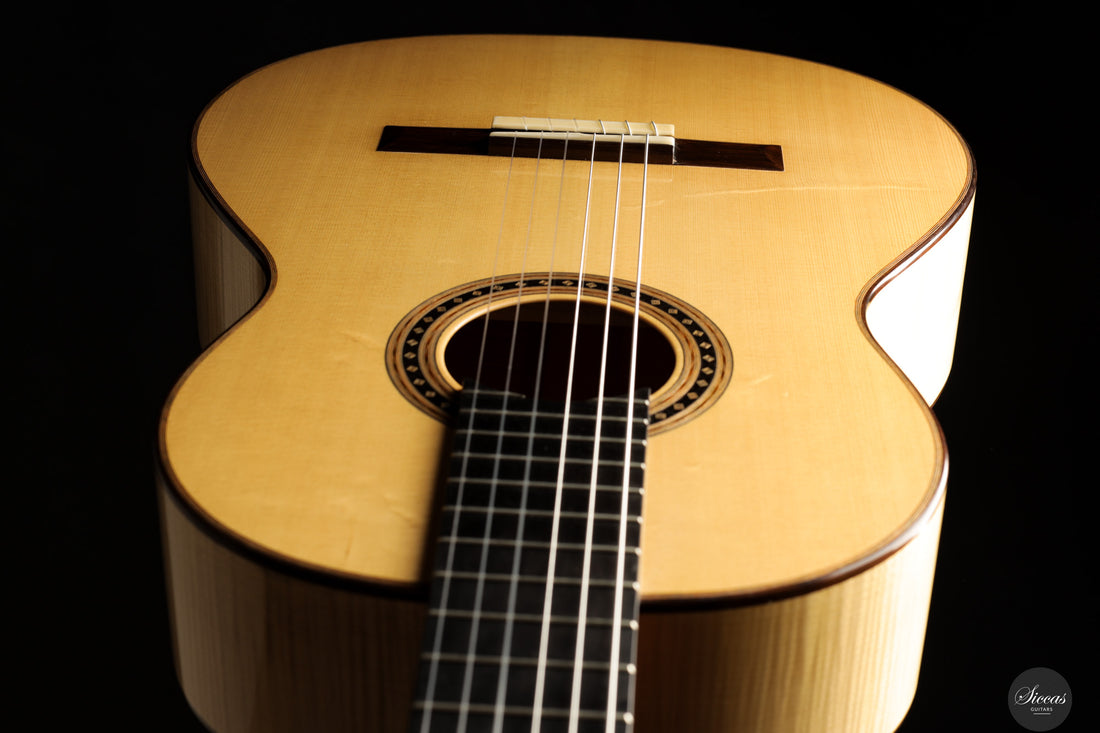
When should I upgrade to a concert guitar?
There is no particular grade or playing standard at which you must upgrade to a concert guitar. It becomes worth considering when another instrument offers something you value: greater sensitivity, more musical colour, a more comfortable feel or simply a sound you enjoy more.

Cedar vs Spruce Classical Guitars: What Actually Changes?
Cedar and spruce have recognisable tendencies, but the better choice comes from the complete guitar: its response, character and what its maker has done with the wood.
Tell us what you currently play, what you would like to change and your approximate budget. We can help you decide what is worth comparing.