
Understanding a classical guitar condition report
A pre-loved classical guitar can carry years of music in its voice and visible traces of use. A condition report helps you understand those traces: what is cosmetic, what affects playing, and what needs explanation. Read it as a dated account of an individual instrument, alongside photographs and your own experience of playing it.

A dated view of condition
Begin with the assessment date, who examined the guitar and the inspection’s scope. Was it visually checked, measured and played? Were internal areas examined with a light, mirror or camera? An inaccessible area should be distinguished from one inspected without finding a problem. Ask whether subsequent work or a setup change has altered the recorded condition.
CGA’s quality assurance process considers structural condition, setup and playability, followed by response, balance and musical character. These require different observations: a secure bridge is a physical finding; a warm, responsive voice is a playing judgement. Neither replaces the other.
Identity and known history
Check the maker, model, construction year and serial or instrument number where present, together with label photographs and identifying features. The report and listing should refer to the same guitar. An original case, changed tuners or an altered saddle may help explain its history, but none establishes a complete ownership record.
Distinguish documentary evidence from accounts passed on by an owner. A repair invoice or maker’s correspondence can substantiate who did particular work and when. An unverified recollection should remain attributed as such. Missing paperwork does not prove that a repair was poor, but it limits what can confidently be said about its history.
Reading cosmetic wear
Scratches, dents, nail marks around the soundhole and worn finish at contact points tell you about appearance and use. Useful wording locates the mark, describes its extent and distinguishes a surface blemish from damage to the wood. ‘Light wear’ becomes clearer when paired with a close photograph and an indication of scale.
Marks associated with guitar supports may include impressions, discolouration or disturbed finish where suction cups, pads or protective films have contacted the sides. Ask what is visible and whether it is confined to the finish; its shape alone cannot establish the cause. A fine line also needs assessment to distinguish finish cracking from a wood crack. CGA’s guide to classical guitar finishes explains why different finishes require different care.
References: 2
Understanding the structure
Structural observations concern the soundboard, back and sides, the bridge’s attachment, and the neck’s connection with the body. Look for clear descriptions of cracks, open seams, lifting or distortion, including location and any recommended attention. A description of the finish alone does not answer these questions.
Where inspected, internal findings may cover braces, linings and other accessible joints or reinforcement. The method and visibility matter: a view through the soundhole is not an examination of every concealed surface. Unwanted rattling may warrant further investigation even when the exterior looks clean. Ask CGA to explain any concern and whether specialist assessment or work is needed before purchase.
Putting repairs in context
A repair entry should explain where the work is, what was repaired, what documentation exists and how it is assessed now. A glued crack, an internal reinforcement and finish retouching describe different aspects of a repair. Ask whether the area is closed, secure and showing any evidence of movement at inspection, and whether further attention is advised.
A repaired crack requires individual evaluation. Its presence alone does not settle the guitar’s suitability; location, repair quality, present condition and playing response all matter. CGA has described a pre-loved guitar with a professionally repaired soundboard crack, separately reporting its structural condition and musical response. That assessment belongs to that instrument. It is not a promise about every repaired crack, or a guarantee of future stability.
References: 6
Playability and setup
Look for observations about fret wear, uneven frets, unwanted buzzing and fretting comfort. Small grooves may be present without causing immediate difficulty; more substantial wear may require levelling and recrowning, or replacement. Ask whether work is recommended now and what it would involve. A buzz needs a diagnosis: action, frets, strings, technique or a loose component may be involved.
Action at the twelfth fret means the distance from the top of that fret to the underside of the string, usually recorded in millimetres for the sixth, low E, and first, high E. Confirm the order of the readings and measurement conditions, including tuning. There is no universal ideal: the instrument, strings and your playing dynamics affect useful clearance. See Classical Guitar Action Explained.
Neck geometry includes relief—the neck’s slight lengthwise curvature—and its alignment relative to the body and bridge. Saddle adjustment capacity matters alongside the current action. High action with little saddle left to lower may need more than a routine adjustment. Ask what changes are realistically possible; avoid assuming any guitar can simply be set lower.
Fittings and the case
Tuners should be assessed for operation as well as appearance: do they turn smoothly, have damaged parts or need attention? Record replacements and other fittings, including any pickup or added attachment, with the scope of functional checks. Decorative tarnish and a mechanism that will not tune properly have different implications.
Keep the case and accessories separate from the instrument’s condition. Ask about case fit, catches, hinges, handle and lining, and confirm what is included. A scuffed case does not make the guitar structurally worn; a beautiful guitar does not establish that its case is protective or serviceable.
References: 5
Wording worth clarifying
These examples are illustrative, not extracts from CGA reports or a CGA grading scale. They show how a short observation can lead to a useful question.
| Report wording | Plain-English meaning | Useful follow-up question |
|---|---|---|
| Light nail marks beside the soundhole | Local playing marks are visible; depth still matters. | Are they confined to the finish, and can I see a close photograph? |
| Previously repaired soundboard crack | Work has been carried out; present condition needs explaining. | Where is it, what was done, and how is it assessed now? |
| Limited saddle adjustment remaining | Further lowering may be restricted. | Can the setup accommodate my playing without more substantial work? |
| Internal inspection limited to visible areas | Concealed surfaces have not all been assessed. | Which areas were inspected, and is further examination recommended? |
From report to decision
Match each significant observation to photographs, requesting another angle or close detail where needed. Then play familiar music across the fingerboard, at the softest and strongest dynamics you use. Notice comfort, unwanted noise, response and whether you enjoy the sound. A photograph records appearance; a playing trial helps establish your musical fit.
Before deciding, ask what needs attention, what has already been addressed and whether any care recommendations or likely costs affect ownership. Keep the report and photographs for future comparison. CGA’s maintenance guide provides a starting point for ongoing care. If anything remains unclear, ask CGA for advice. The report is most useful when it makes your decision more informed and your next questions more precise.
References
Reporting principles and technical explanations inform this guide. They are separate from the assessment of any particular guitar. The example table is illustrative.
- Collections TrustCondition checking and technical assessment — suggested procedure
Dated observations, identification, methods, limitations and photographic records; reporting principles only.
- Frank Ford · FRETS.COMLooking at Cracks
Distinguishing finish cracking from cracks in wood.
- Frank Ford · FRETS.COMLooking at Frets
Fret wear, unevenness and the limits of levelling worn frets.
- Frank Ford · FRETS.COMFingerboard Wedge
A classical-guitar repair illustrating high action with an exhausted saddle adjustment; an individual example, not a general prescription.
- Yamaha · Musical Instrument GuideCare and maintenance of the tuning keys
Tuner function, stiffness and damaged components.
- Classical Guitar AcademyPre-loved listing: Antonio Picado Concierto DT (2025)
An individual repaired-crack example describing location, a named repairer, structural condition and playing response. A listing, not a standalone condition report.
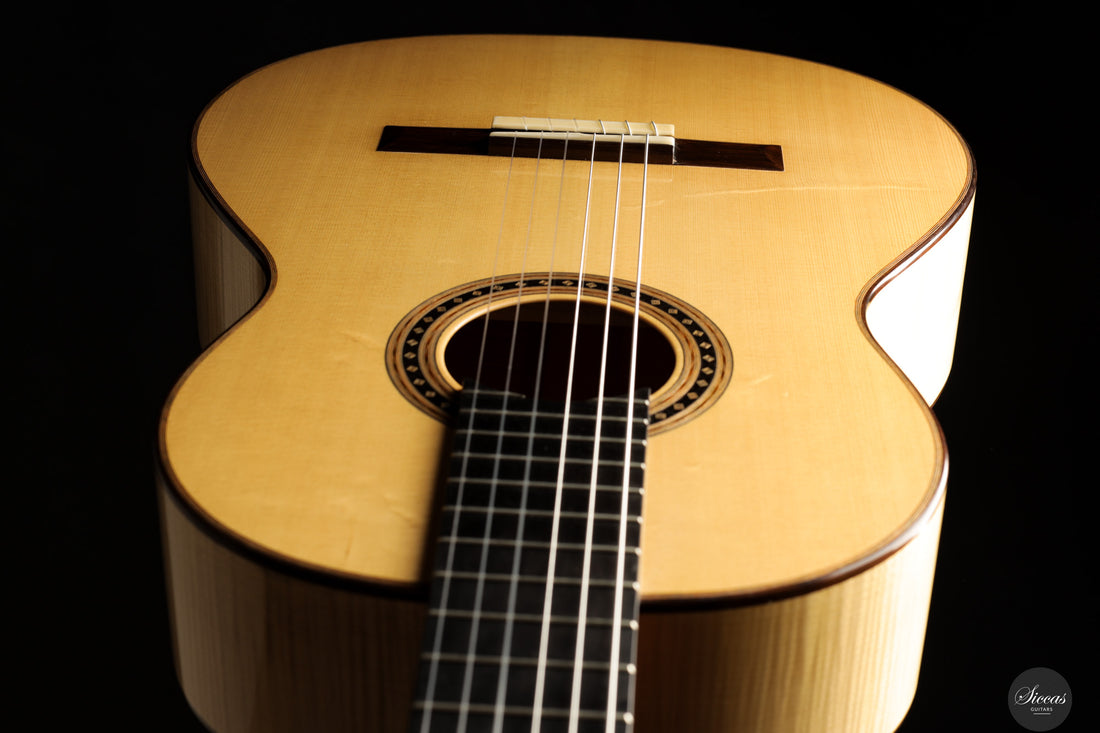
The guitar-detail photograph comes from CGA’s Robert Cross Concert (1993) gallery.
Keep exploring
Read more about choosing a classical guitar, then explore the instruments currently available at CGA.

What defines a concert guitar?
Explore the materials, craftsmanship, projection, refined sound, tonal colours and playability that define a concert classical guitar.
When should I upgrade to a concert guitar?
There is no particular grade or playing standard at which you must upgrade to a concert guitar. It becomes worth considering when another instrument offers something you value: greater sensitivity, more musical colour, a more comfortable feel or simply a sound you enjoy more.

Choosing a classical guitar scale length
Scale length is the nut-to-saddle length of the vibrating string. It sets the spacing of the frets and helps determine string tension, shaping how a guitar feels under the hands and contributing to how the complete instrument responds.
Tell us what you currently play, what you would like to change and your approximate budget. We can help you decide what is worth comparing.